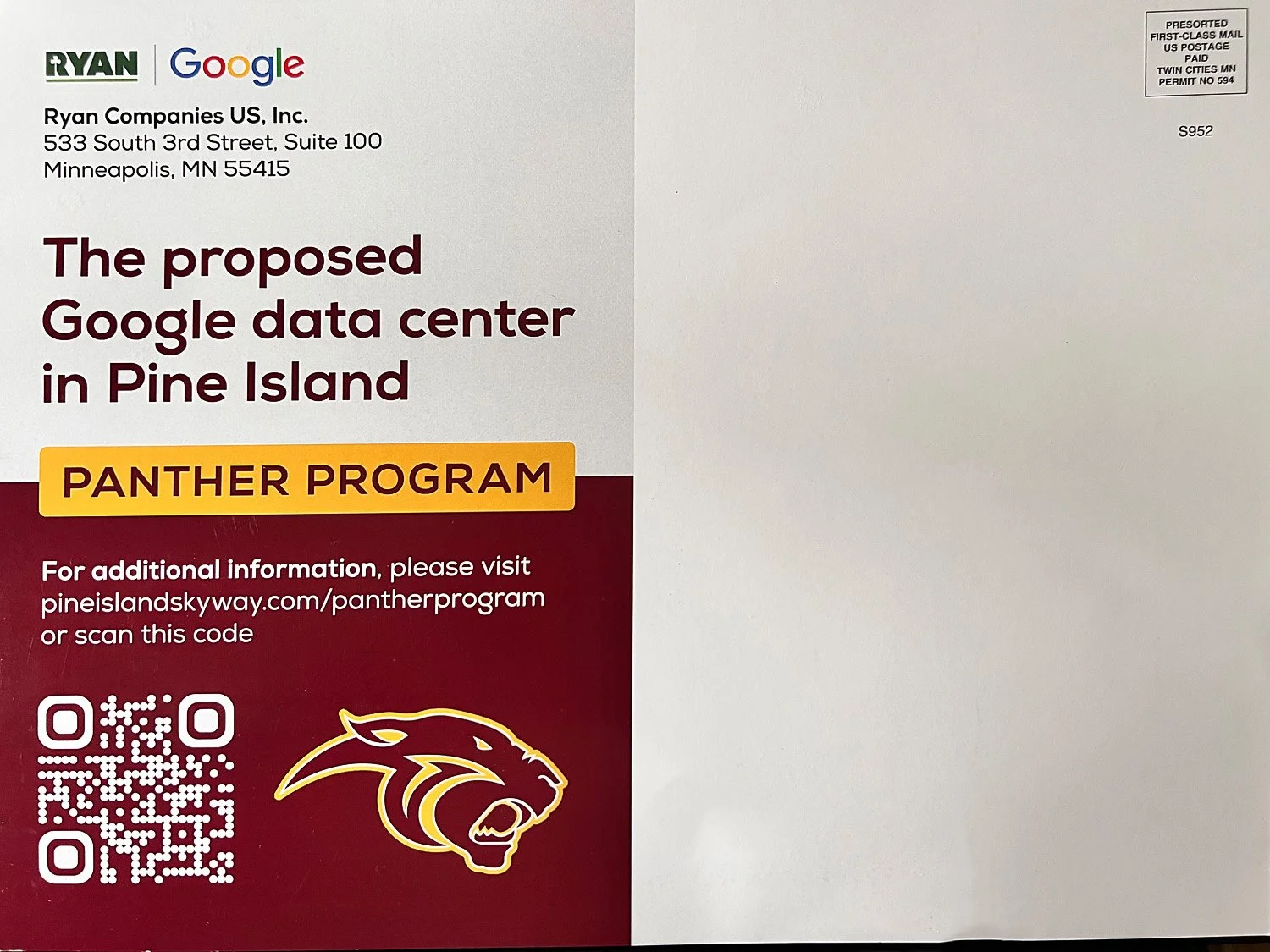
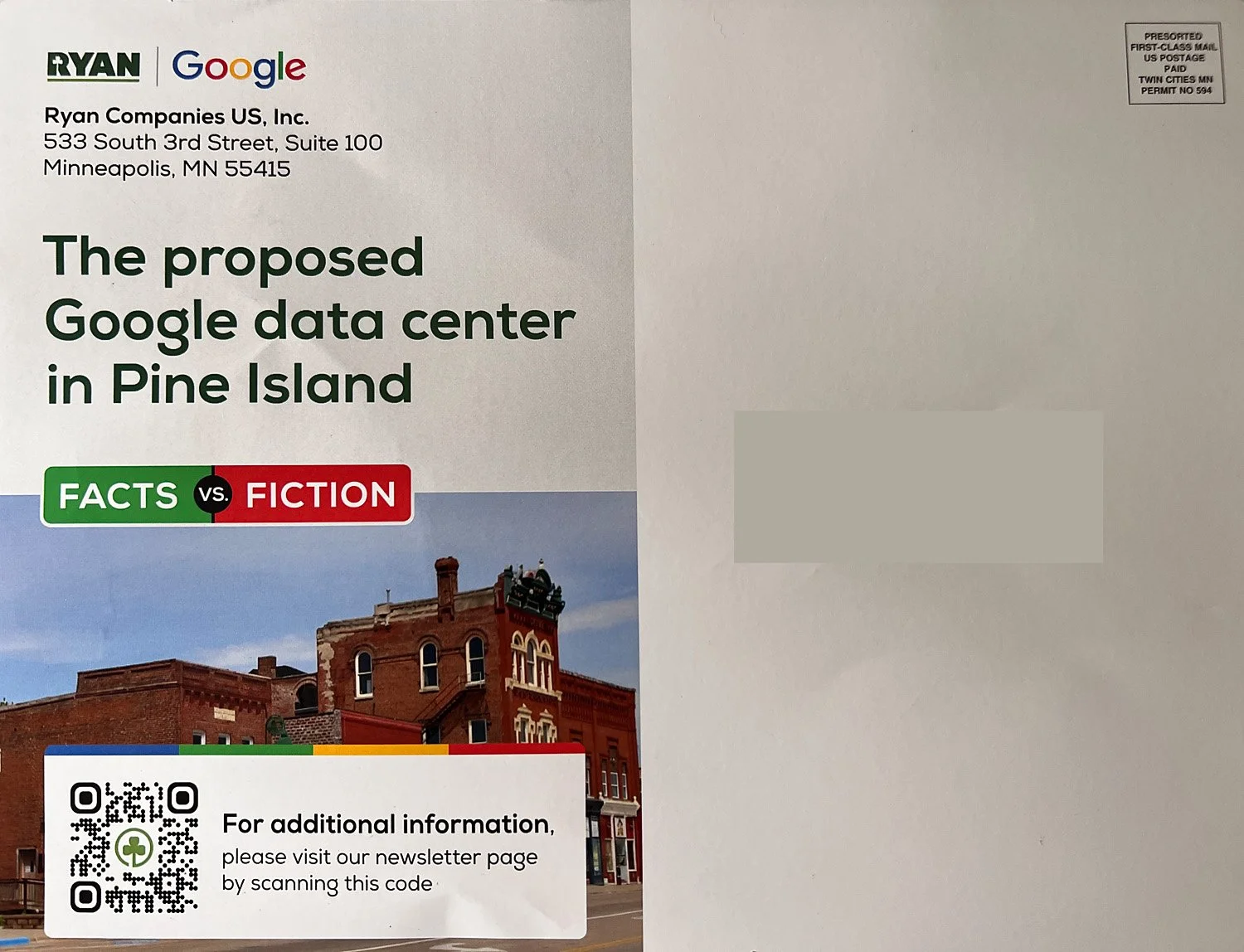
They call it factual information. We call it propaganda.
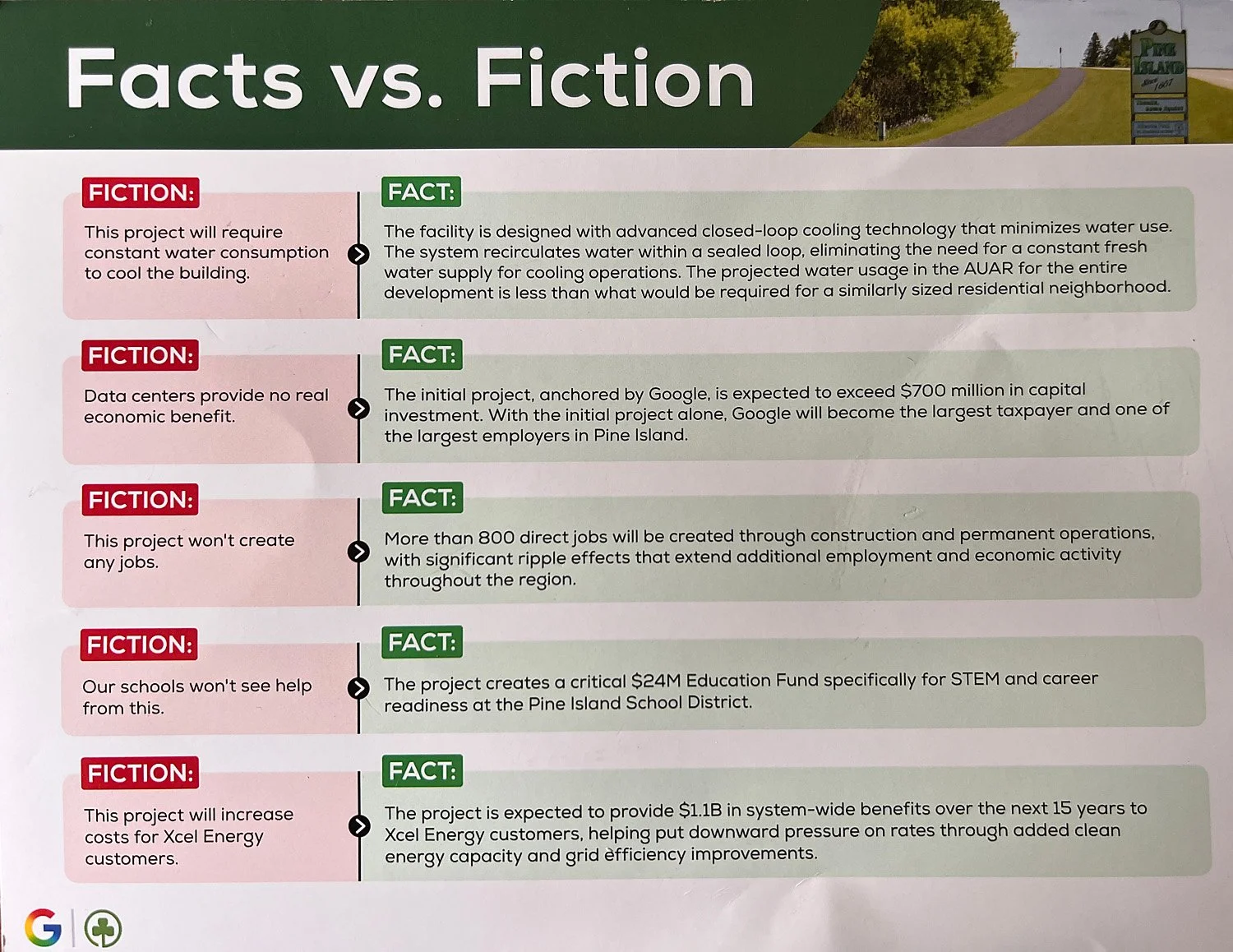
Fact vs. Fiction
Water
The whole truth about water. Ryan Co. and Google report the data center will use up to 152,000 gallons of water per day for “typical office/light industrial domestic purposes” and that this is comparable to a residential development the same acreage. They also claim there will be 100 permanent jobs. How do 100 people use 152,000 gallons of water every day for domestic purposes? They are not being transparent. Also 152,000 gallons/day brings Pine Island nearly to our limit of appropriated water; therefore, any increase in population and water need will require Pine Island to get a new water permit from the DNR. On top of that, Rochester is anticipating a water shortage by 2031 and have already been denied a new water permit from the DNR and both cities use the same aquifer.
Ryan Co. and Google state they will use a closed-loop chilled water system that “completely eliminates the need for a constant supply of fresh water.” But none of this information was included in the environmental review, which only says “air cooled” (p.27 AUAR). Per conversation with Google reps during the 6/15/26 open house in Zumbrota, it will require 1.5 million gallons of water to fill the closed loop system. This water usage was left out of the AUAR environmental review when it should not have been. Closed loop systems still have leaks. When leaks occur, they need to be repaired by draining the area and refilling it. The process for addressing leaks should have been listed in mitigation strategies. Closed-loop systems are not just filled with water but also chemicals including nitrites, glycol, and PFAS to prevent pipe degradation and biological growth. When asked about what chemicals they use the Google rep did not have an answer. When a leak happens and the system is drained, the chemicals are drained as well into our wastewater treatment plant, and we do not have confirmation that the treatment plant can clean out the chemicals and prevent them from entering the Zumbro river. Furthermore, as stated on p.27 and 28 of the AUAR “no industrial wastewater is anticipated” and without industrial wastewater being even considered an entity would not have an industrial wastewater permit, like Land O’Lakes, and the pre-treatment requirements to remove harmful chemicals prior to entering the publicly owned and paid for wastewater treatment facility that are a part of the industrial wastewater permit do not kick in. Finally, there is a larger water impact broken up into direct and indirect water use. A closed-loop system has increased electricity demands, which means the power plants will use more water to produce the electricity. That water use is just pushed onto a different entity (power plant) and Google can claim they are using less water.
Energy
The whole truth about energy. Ryan Co. and Google chose land in Pine Island which is conveniently located in close proximity to the North Rochester Substation located on the northern edge of Pine Island right off of Highway 52. Full build out of the Google hyper scale AI data center will use 2,700 MW (2.7GW) of energy based on court records (index #63 p.19 case 25-CV-25-2298).. For perspective, the city of Rochester uses about 291 MW. As part of Google’s plans with the PUC, the current substation will need to be expanded by 11.3 acres, doubling it in size and a 1.2 mile double circuit 345kv transmission line will be added. This 345 kv line is explicitly for the data center campus and will connect to 4 smaller substations (docket 26-135). Google has said they would pay for this specific infrastructure. However, there are several new high voltage transmission line projects all colliding at the North Rochester (aka Pine Island) substation: PowerOn Midwest, Gopher to Badger Link, and the Mankato to Mississippi. These three projects alone will bring two 765 kV, three 345 kv and two 161 kv transmission lines into the existing substation before Google doubles its size. All of those transmission lines are tax payer (all of us) funded which will increase your electric bill. PowerOn Midwest alone is costing ratepayers over $3 billion.
BESS (Battery energy storage systems) has a role to play in renewable and cleaner energy solutions. But what’s being planned here, the “world’s largest battery”, is currently untested at this scale and was announced via news articles after all project approvals were given, with no mention of it before then, no environmental review performed, no safety plans or decommissioning plan included and no conversation about whether surrounding fire departments can handle it. It is unethical to drop the world’s largest experimental technology on any community without informed consent. Based on the Electric Service Agreement (ESA docket 26-170 p.12) this battery requires a 2.5:1 ratio as far as power equivalencies, which means whatever power demand you’re trying to back up you need 2.5x that total in battery storage. At full 2,700MW build out it would require 6,750MW of battery storage to provide back up power without backup generators. This battery requires 100 acres per 300MW. To get 100 hours of back up power for the full build out without diesel generators it would take 2,250 acres just for that. And that’s assuming there aren’t additional buffers and permitting needs that require any more space. How many of these batteries they aim to ultimately have in total is trade secret, along with all other crucial pieces of information (see whole PDF of ESA). They have also failed to mention the 50MW diesel generators they now say will be needed for backup energy on site, but we don’t know how many will be needed, how often they will run, or how much air pollution they will create. Finally, they claim to be using clean energy but fail to mention it is not specifically to power the data center, it will just be added to the grid (p.10 & 11 ESA).
Key “Facts”
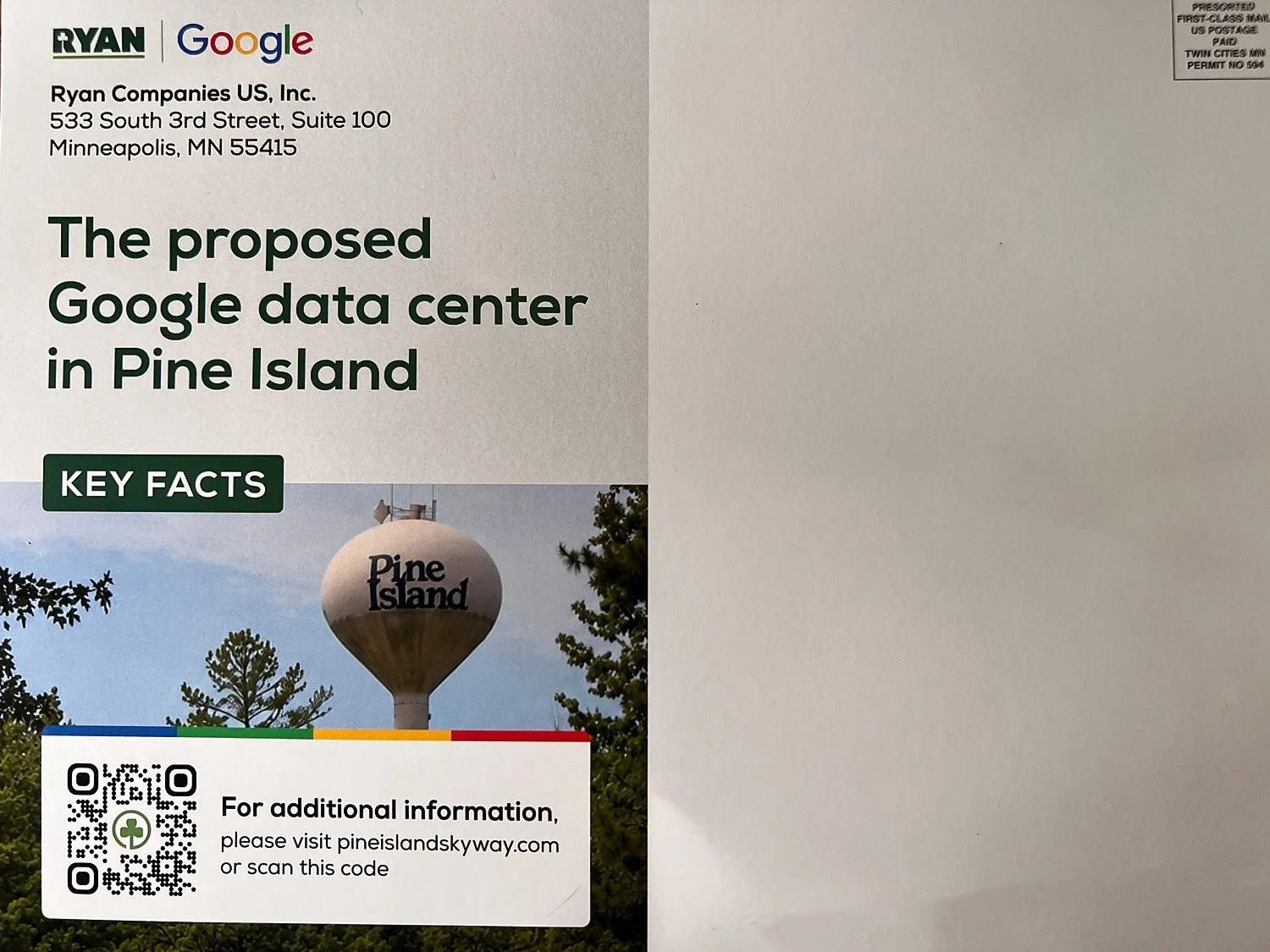
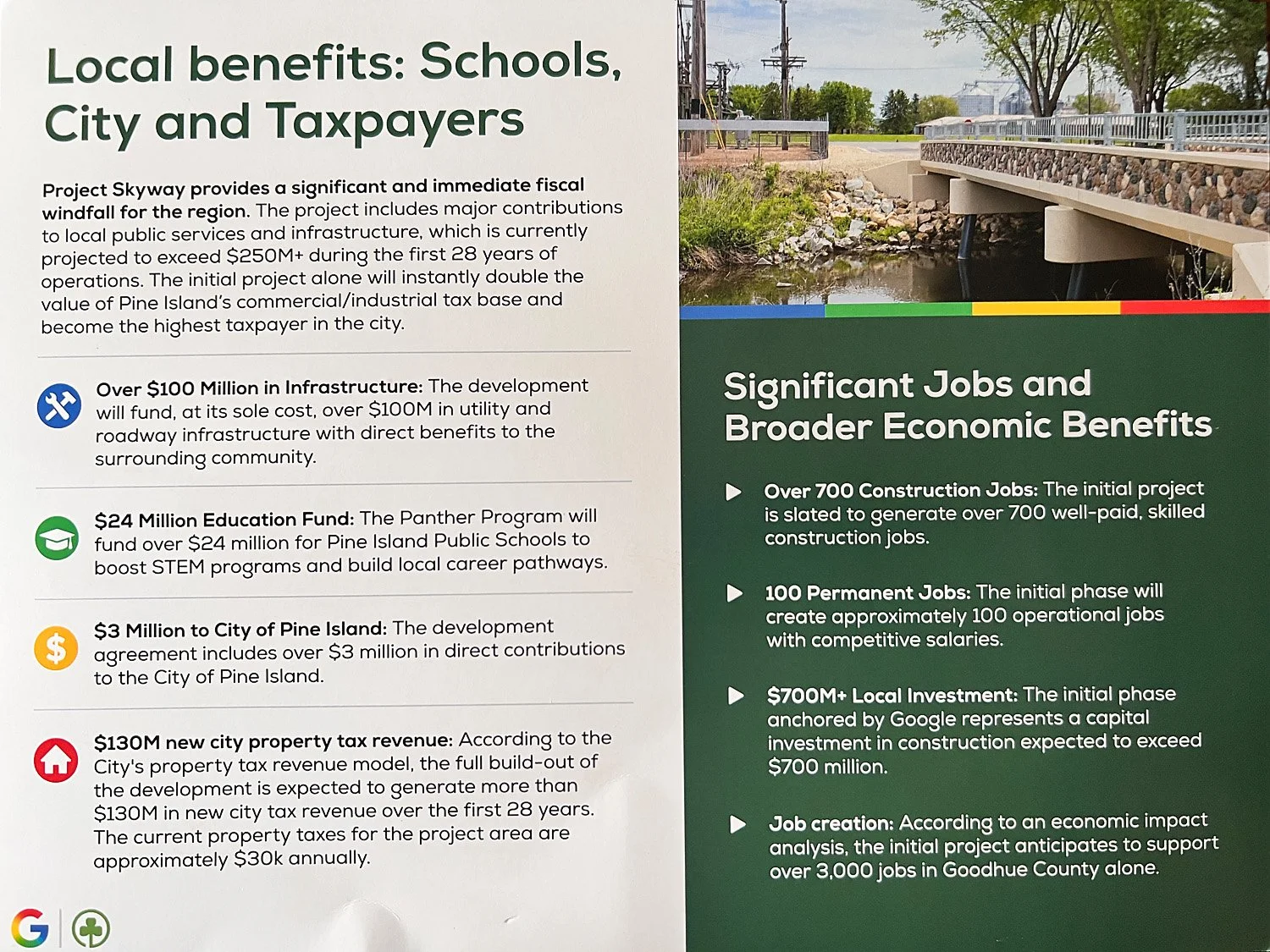
If only Ryan Co. and Google had wanted to celebrate with our community BEFORE they invited themselves to town and steamrolled their way through approvals for their “project.” A few free BBQ sandwiches, bounce houses and live music were offered as our consolation prize for “winning” the hyper scale AI data center lottery. Now that Project Skyway has been outed to the community as a hyper scale data center, they have gone into crisis management mode. What does this mean? Expect more “free” hotdogs coming your way.
Community Celebration
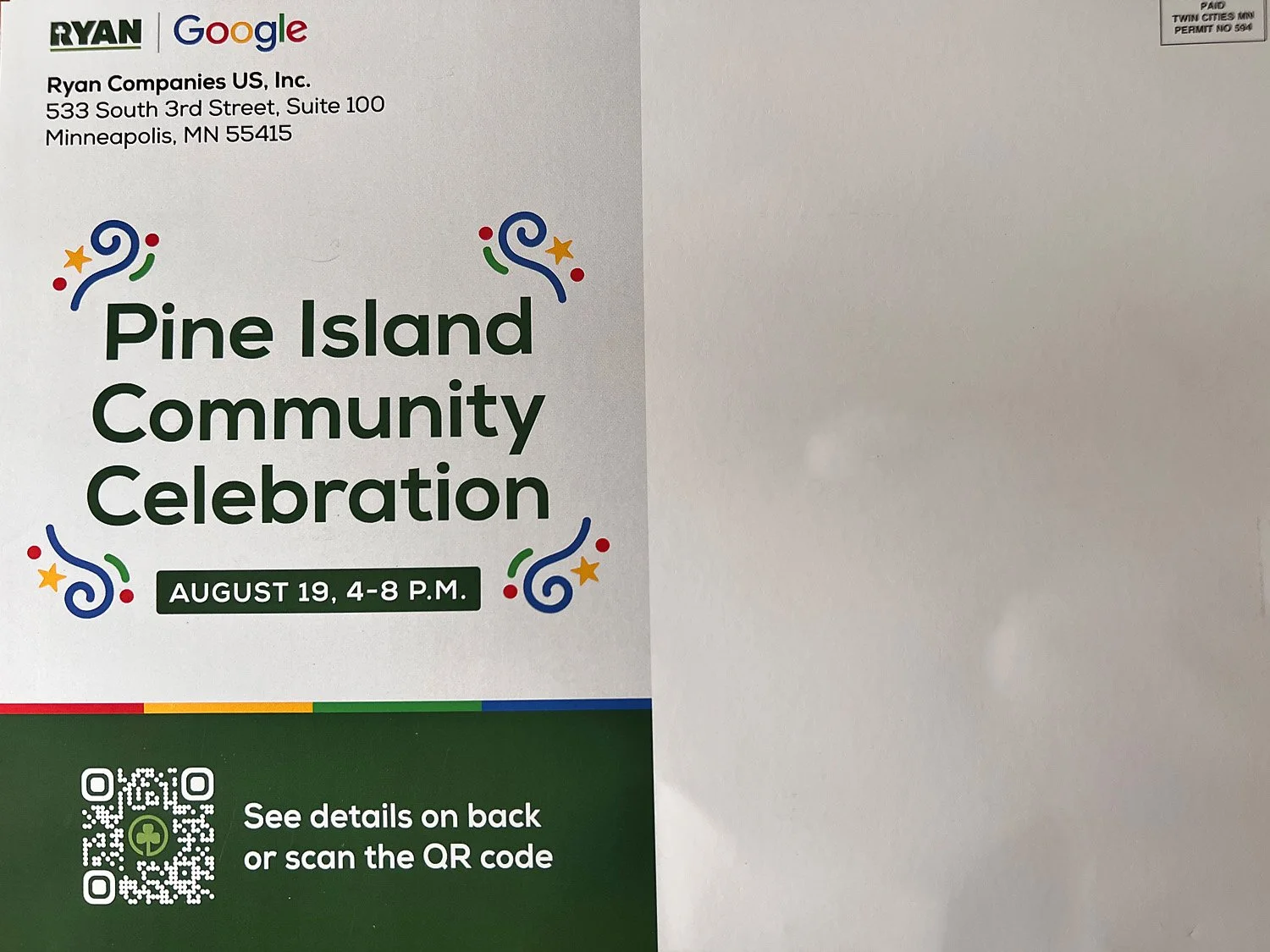
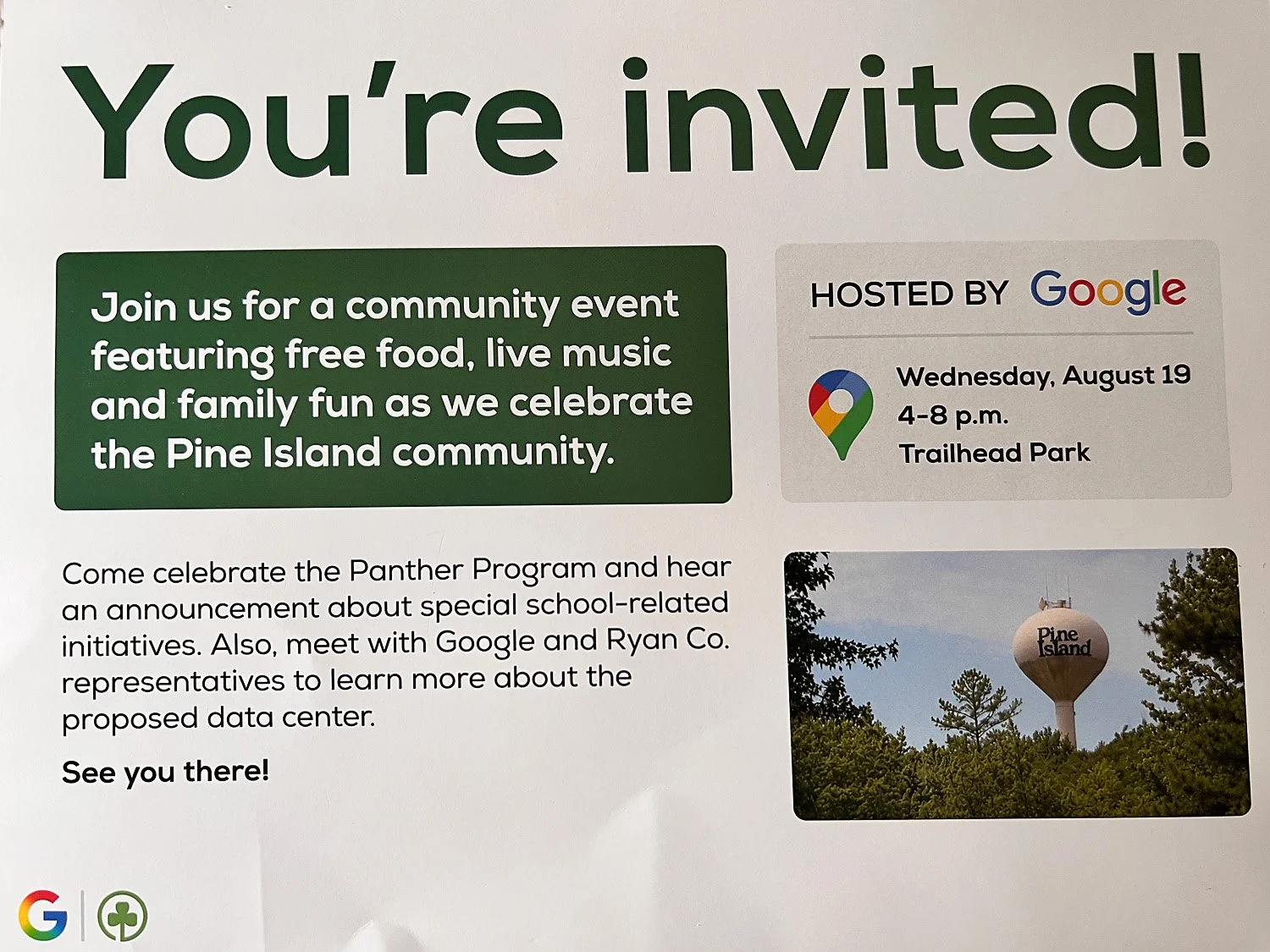
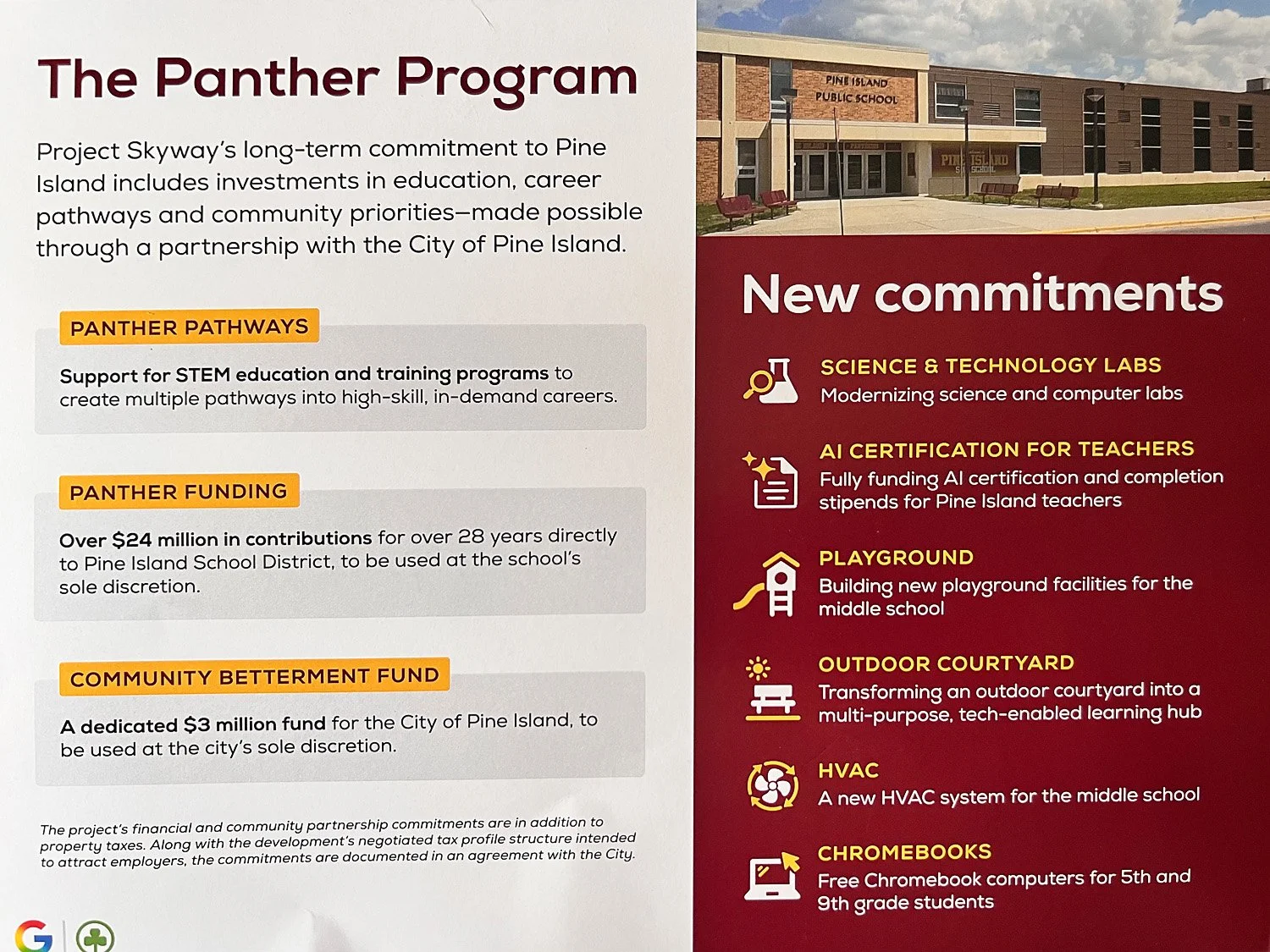
These “New Commitments” came about recently. Could it be assumed these additional offerings are in response to our No Data Center group resistance? You decide. Our efforts have, no doubt, been somewhat of a motivator for Ryan Co. and Google to “reach out” even more in our community. If they can’t persuade us with their “facts,” they’re hoping we can be persuaded by money. And as they’re in the business of AI hyper scale data centers, they are encouraging the use of AI in our schools by paying for AI certification for our teachers.
Panther Program