Frequently Asked Questions
-
Data centers are buildings housing a large network of computers that perform a variety of services from creative AI to bitcoin mining to cloud storage and computing.
-
Phase 1 has 4 data center buildings along with 4 individual substations for them (PUC docket 26-135 4/28/26 initial filing route permit with appendices). Building 1, a 300K sq ft data center was approved in January 2026 by the city. Final PUD/Platt plans listed “3 potential future buildings” of unknown purpose or details in the drawing. In March in court records (index 63 case 25-CV-25-2298) those other 3 buildings were revealed to be 3 more data center buildings through Google’s shell company Echo Zone LLC. Those buildings are on PUC docket 26-170.
The square footage of all 4 data center buildings has not been disclosed. On 10/9/26 in response to XLI’s motion for a contested case and the MN Dept of Commerce finding the MW publicly available through MISO’s spot load approval (p.45), Google admitted on p.7 phase 1 is 780MW. Building #1, the 300K sq ft data center would be more or less equivalent to FIVE football fields. The data center buildings will be 60 feet tall as well (two school busses stacked end-to-end) not counting any equipment on top of the roof.
The world’s largest battery was also announced via news articles in March 2026. That is also on PUC docket 26-170 and not mentioned anywhere in city ordinance or any project plans put before the city.
-
We have many reasons to oppose this development.
1) Lack of transparency
We’ve learned more about this project from news articles and the court documents than we have from the environmental review. NDAs and project code names were used to keep the community at large in the dark about the true nature of the project.
Data Centers are known to produce infrasound and low frequency noise pollution, which is documented as harmful to humans and animals. Right now, we have no regulations protecting us from this sort of sound pollution.
Air pollution from backup generators is a significant issue and the AUAR states the CO2 emissions (air pollution) from Project Skyway are 3,429,807 tons annually. That’s the equivalent of 8.1 gas plants. Per the World Health Organization, air pollution is linked to mental health and psychological disorders, premature death, asthma, lung cancer, heart disease, adverse pregnancy outcomes etc.
3) Impacts to the environment
We cannot survive without water. We have a finite amount of clean water and we are charged with being good stewards so future generations will have water.
Heavy metal contamination in water systems comes from air pollution as well as other sources like lead pipes. Mercury in particular is linked to air pollution (impaired waters lists). In addition to water demandsthat out pace what’s available or sustainable, data center wastewater is another regulatory gap where these massive projects use PFASand are discharging their cooling water into watersheds like the Zumbro River.
Project Skyway stated in the AUAR that no industrial wastewater would be produced yet in January’s zoning meeting it’s documented (p4) that there will be an undisclosed amount of effluent discharge, with undisclosed chemicals in unknown amounts disposed of off-site and into the local wastewater treatment, which discharges directly into the Zumbro River.
4) Energy
Project Skyway is noted to have a power demand of 2700MW at full build out (index 63 case 25-CV-25-2298). That’s 9x the energy use of the city of Rochester, MN. Phase 1 is now confirmed at 780MW. Ratepayer energy bills have already been going up at the same time Xcel and Google swear up and down it has nothing to do with data centers. The Citizen’s Utility Board of Minnesota also has concerns that ratepayers are not being protected as they should be.
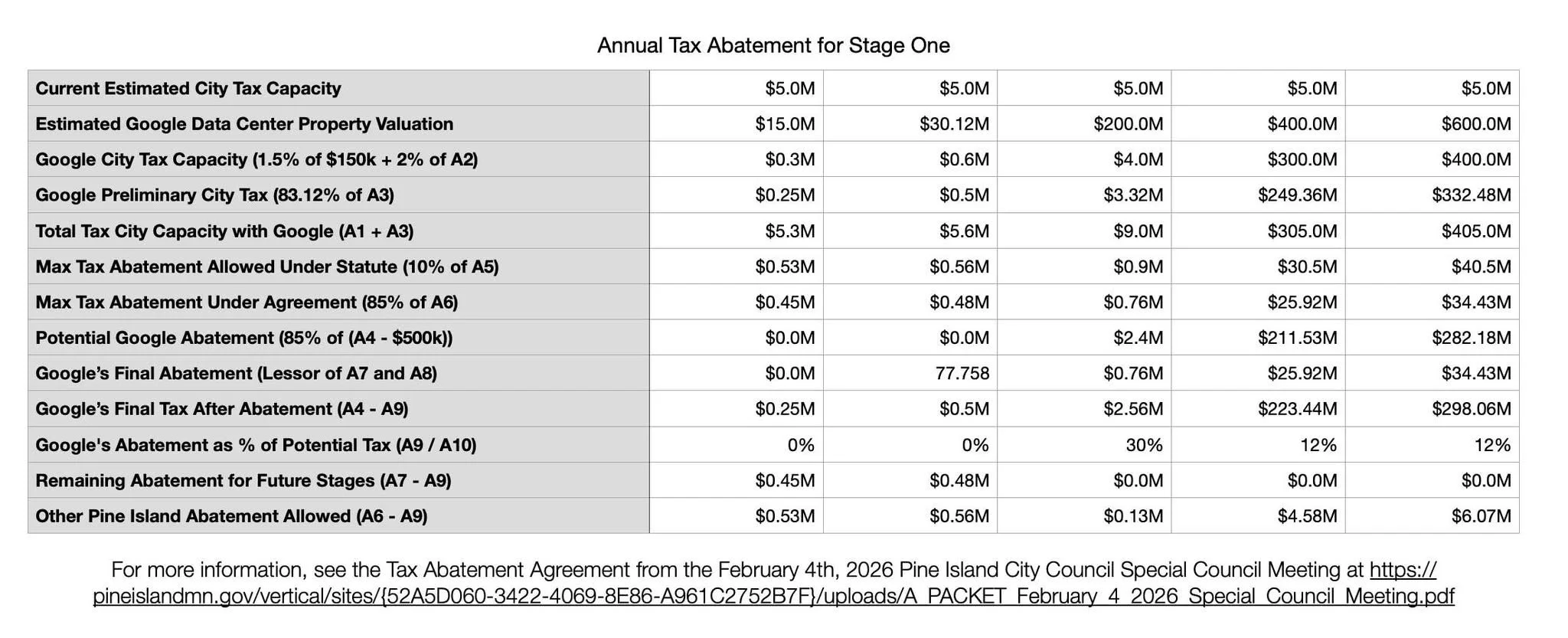
The city approved a $36 million dollar tax abatement in February 2026 to Google. They began rewriting the city code in early 2025 to ensure a trillion dollar company would get a tax break. Yet they hadn’t bothered to rewrite or update city code to benefit the local small businesses already here. The city is giving up 85% of what it’s allowed to offer in tax abatements for one project and locking the city into that problem for 28 years. (See Teddy Kimble’s spreadsheet info on the abatement in the photo to the left).
6) Permanent loss of rural identity
Pine Island is a small, rural, farm town. This massive industrial development will dramatically and permanently change our identity. That kind of decision belongs to the community, not big tech.
-
This is the equivalent of saying that because you use roads and/or drive a car you should allow anyone to drive drunk on them without repercussions.
Phones, social media and internet were being used before hyperscalers came into play. Hyperscale facilities are a new beast without proper regulations and safeguards. Those safeguards need to be in place. No one has paused long enough to truly study the actual demand and buildout needed. AI is often embedded into systems and platforms, leaving consumers without a real choice in whether they truly want to use AI or even see it as being a beneficial tool to them.
-
According the City Council’s own website, this project was in the works since late 2023, which was not disclosed until November 2025 after data requests were submitted. A code name (“Project Skyway”) and euphemisms (e.g. “Technology Center” or “Technology Park” as opposed to “Data Center”) were used to cloak the actual nature of this development from robust public scrutiny, which worked until September 2025 when five moms raised the alarm about it. City officials maintained in public meetings that they did not know it was going to be a data center development despite a data request disclosing emails between the developer and city official(s) exposing conversations specifically about developing a data center in Pine Island going back to January 2024.
-
According to the Pine Island City website: “No one on city council or the planning commission has signed NDAs. Two staff members, our city administrator and deputy city administrator, have signed NDAs.”
What they leave out is the city engineer who is contracted to help assess this data center project also signed an NDA. This was discovered through a local citizen’s data request and not volunteered. Pdfs of NDAs
-
No, AI Data Centers are more resource intense users. They present unique regulatory challenges that traditional data centers do not present. For further information about these differences (click here). Visual diagram.
-
Check out our Stop the Pine Island Data Center Youtube page, we’ve created several playlists to learn about the complex issue of data centers.
https://www.youtube.com/@StopthePineIslandDataCenter
Prefer to listen to learn? Check out our Podcast playlist!
-
Q. How do I access MN court records?
Or go to https://publicaccess.courts.state.mn.us/, click “case search,” click “business,” type in “City of Pine Island,” click on 2nd result case #25-CV-25-2298. We already did the work here.
Q. How do I access the PUC dockets?
Or go to https://efiling.web.commerce.state.mn.us/documents , top left corner type in docket number, then click blue “search” button.
Docket 26-170 is the ESA (Electric Service Agreement). This is what Google will pay Xcel as a Very Large Customer (VLC) and is required by the 2025 law that is supposed to make VLCs pay their share without putting it onto ratepayers. It also includes the world’s largest battery and 50MW of back up generators for Project Skyway.
Docket 26-135 is the 1.2 mi double circuit 345kv transmission line, doubling of the existing substation and the 4 individual substations needed for Project Skyway.
Docket 25-121 is the Gopher to Badger 765 high voltage transmission line coming from WI into southern MN (Maribell line) up to Pine Island.
Docket 25-117 Power On Midwest 765 High Voltage transmission line going from South Dakota into the bottom western part of Minnesota up to Pine Island.
Docket 23-157 Mankato to Mississippi 345kv Transmission line going from Mankato to Kellogg, connecting in Pine Island.
Q. How do I make a public comment on the docket?
There are multiple ways to submit a comment on a docket. The fastest way is by direct submission via efiling through edockets. See instructions here.
Q. How do I file a records request?
Check out Minnesotans for Open Government for how-to videos, sample requests and tips and resources for understanding the Minnesota Government Data Practices Act.
Q. How do I check violations?
Good Jobs First has a violation tracker, a tax break tracker and a subsidy tracker to make it easy to check if a company is following the law and what kinds of tax money the state is losing from offering them tax breaks.
Q. How do I look up LLCs in Minnesota?
Go to the Secretary of State website and type in the LLC name “ie: Echo Zone LLC” in the search to see if the business is registered in MN. The LLC might have the home state elsewhere. Businesses need to be registered in both MN and their home state. You can search other states for LLC look up (hint: check Delaware).
Q. How do I get alerts about environmental review and make public comments?
Sign up for the EQB monitor to get notified when environmental reviews are submitted. Learn about the different kinds of environmental review in Minnesota. Here are some tips for making public comments on environmental review. (Note the 2nd link is from 2005 and commenting periods have since been updated).
Q. How do I look up campaign finance records?
See this short video explainer here. Open Secrets and Little Sis help you follow the money. Go to “reports and data” at the Campaign Finance Board to look up campaign contributions filed for state candidates.